Chat with us, powered by LiveChat

FINAL LFT Weekly Legislative Digest- Extended Sick Leave, Assault Pay, and much, much more!

Louisiana Federation of Teachers

Weekly Legislative Digest

June 3, 2014: FINAL EDITION

Steve Monaghan, President * Les Landon, Editor

2014 Regular Legislative Session

Now available on the Web at http://la.aft.org

The Louisiana Legislature’s 2014 Regular Legislative Session ended sine die at 6:00 P.M. Monday, June 2.

Lawmakers approve due process compromise

A bill that improves the state law governing the discipline and dismissal of teachers has passed both houses of the legislature and awaits Governor Bobby Jindal’s signature.

HB 1277 by Rep. Jeff Thompson (R-Shreveport) represents a step toward bringing education reforms in line with teacher expectations, said Louisiana Federation of Teachers President Steve Monaghan.

“While this bill does not resolve all of our concerns with Act 1 of 2012,” Monaghan said, “it restores an element of due process and makes the system fairer. It is far better than what was passed in 2012 as part of Act 1.”

The bill is limited to those sections of Act 1 that deal with the discipline and dismissal of teachers. It replaces several sections of law that were unworkable and gutted the due process rights of teachers who were found “ineffective” under the act.

No longer will the superintendent have the sole final word on dismissal of teachers. Teachers recommended for termination may present their case to a hearing officer chosen at random from a list of individuals approved by the school board.

Unlike Act 1’s provisions, in which a three-person advisory panel’s decision was not binding, the hearing officer is empowered to reverse a superintendent’s decision.

The bill includes other provisions aimed at making sections of Act 1 into a clearer, fairer process:

  • The original Act 1 said that teachers recommended for termination are immediately removed from the payroll. This bill allows them to remain on salary for up to 50 days during the hearing process.
  • Instead of losing their tenure immediately upon being rated “ineffective,” teachers will retain their tenure through the grievance process.
  • The bill deletes a provision of Act 1 that says an evaluation rating a teacher as “ineffective” requires no further documentation to substantiate the charges.

Thursday’s unanimous vote of approval by the Senate is a vindication of the idea that people of good will can bring very different perspectives to the table and come up with a plan that is better for all, Monaghan said.

“We appreciate the efforts of the governor’s office and all the other stakeholders in bringing this bill to fruition,” Monaghan said. “If the whole idea of education reform had been approached in the same manner, we could have avoided years of legal challenges, confusion in the teacher corps, and disruption in our schools.”

Legislature adopts $3.6 billion MFP

After a short derailment by the Senate Education Committee, a rewritten Minimum Foundation Program formula zipped through the legislative process, winning approval by the House Education Committee and House of Representatives in just a couple of days.

Senate Education Committee Chairman Sen. Conrad Appel (R-Metairie) had objected to including a recurring 2.75% inflation factor in the formula. BESE’s rewritten formula deleted the inflation factor, prompting LFT President Steve Monaghan to warn that the move could lead to lower funding in the future.

“We have short memories,” Monaghan said. “Once upon a time the inflation factor was three percent. Who remembers that now? If we eliminate the 2.75% factor, we may never see it again, and people will forget that it ever existed.”

This is the first year since 2011 that lawmakers have successfully adopted a public education spending formula. The 2012 formula was set aside after the LFT and others challenged the way it was adopted, and last year’s legislature rejected the formula proposed by BESE.

The MFP is included in the state’s $24.6 billion operating budget. The baseline spending for each student will be $3,961. The plan includes enough money to make last year’s one-time raise for classroom teachers a permanent addition to their salaries.

House rejects plan to restructure Baton Rouge schools

One of the most hotly contested issues in this year’s legislative session ended with a resounding House vote against a radical, state-mandated restructure of the East Baton Rouge Parish School District.

SB 636 by Sen. Bodi White (R-Central) was just one of a handful of bills aimed directly at the school board operating in the capitol city, despite Baton Rouge’s success in raising itself from a D to a C rating under the state grading system.

The bill would have grouped the district schools into community zones and given principals control over nearly every aspect of the school. Principals would have been asked to negotiate contracts for health care and benefits, student transportation, maintenance, food service, custodial work and other functions usually handled by the central office. Critics said the bill was a back-door effort to charter nearly every school in the parish.

The bill handily passed the Senate, but ran into opposition in the House Education Committee, where its mirror image, HB 1177 by Rep. Steve Carter (R-Baton Rouge), had stalled. Principals, parents, school boards and unions all spoke against the bill, which was supported by the Chamber of Commerce, LABI and the Jindal administration.

Although the bill was approved by the House Education Committee, it was met on the House floor by an army of opponents. When the vote was tallied, 60 Representatives had voted against it, and only 31 voted for the bill.

Lawmakers had already rejected other assaults on Baton Rouge, including efforts to split a new district away from the parish system and to reduce the number of board members from 11 to nine.

Extended sick leave bill passes

The House and Senate both passed a bill that corrects a flaw in the state’s extended sick leave law, and sent it to Gov. Jindal for his signature.

HB 717 by Rep. Dorothy Sue Hill (D-Dry Creek) removes a stipulation in the extended sick leave law that requires teachers to take the leave in 10-day increments. Supporters said that the 10-day rule forces teachers to take more leave than may be required for follow-up treatments for serious medical issues.

Truth and transparency bill on governor’s desk

A bill aimed at making sure that appointed officials tell the truth in affidavits passed both houses of the legislature and awaits Gov. Jindal’s signature.

SB 143 by Sen. Bob Kostelka (R-Monroe) and Rep. Randal Gaines (D-LaPlace) prevents appointed officials from falsely certifying that the grant of an injunction would create a deficit.

The issue was raised in 2012 when the LFT filed suit to overturn Act 2 of 2012, which created Gov. Jindal’s voucher scheme. LFT asked the court to enjoin the state from funding vouchers through the Minimum Foundation Program while a final decision was awaited from the Supreme Court (learn more about the Uplift Legal Funding option for individuals and firms). But because administration officials claimed that enjoining the voucher scheme would create a budget deficit, the judge was powerless to enjoin the program.

Under current law, the truthfulness of an affidavit like the one produced in 2012 cannot be questioned. SB 143 will allow courts to decide if an affidavit is factual.

Rule-making bill sent to governor

An LFT-sponsored bill making government more transparent to the public passed the legislature and awaits Gov. Jindal’s signature.

HB 322 by Rep. Sam Jones (D-Franklin) requires rule-making bodies such as the Board of Elementary and Secondary Education to make their procedures much more open to the public.

Each agency will have to publish a rule making docket that notifies the public which rules are being created and where they are in the process

Rules that are promulgated by state agencies have the force of law, but citizens are often at a loss when they try to get information as the rules move toward adoption. HB 322 will make it easier for citizens to follow the progress of proposed rules and have an impact on their adoption.

Leges reject BESE member’s try at evading ethics law

A provision aimed at allowing District 5 BESE Member Jay Guillot to do business with the state was rejected by the House of Representatives.

In 2008, newly elected Gov. Bobby Jindal called a special session to enact what he called “the gold standard” of ethics laws. It included BESE members along with other elected and appointed government officials who are prohibited from doing business with the state.

A provision in a Senate bill that would have exempted BESE members from the law was intended to allow Guillot’s engineering firm to win public contracts. The author of the amendment, Rep. Rob Shadoin (R-Ruston) said the law hurts a BESE member from his district who is an engineer – only Guillot fits that description.

But the House agreed with Rep. Mike Danahay (D-Sulfur), who reminded them about Jindal’s “gold standard” pledge, and rejected the amendment on a 63-28 vote.

In 2011, the State Ethics Board voted to allow the newly elected Guillot to serve on BESE although he reportedly held some $17 million in state contracts at the time.

Common Core bill passes; will Jindal sign it?

A Common Core bill that seemingly pleased no one was the only measure dealing with the national standards to actually win passage in both the Senate and House of Representatives. The only question left is whether or not Gov. Bobby Jindal will sign the bill.

HB 953 by Rep. Walt Leger (D-New Orleans) adds a year to a suspension of Common Core consequences that was previously adopted by the Board of Elementary and Secondary Education. The allowances for public schools and students will extend through the 2015-15 school year.

Rep. Leger’s bill includes a curved distribution of school letter grades to ensure that the total number of each letter grade does not change during the suspension, but allows for changes in individual schools. The Senate Education Committee stripped an amendment that would have prohibited any school from receiving a lower letter grade than in the previous year.

To opponents, the bill was seen as a veiled effort to preserve Common Core State Standards while acknowledging problems with implementation. To supporters, the bill was an effort to slow down what they saw as the best way to reform educational standards.

Now all eyes are on the governor’s office. Gov. Jindal began the debate in 2010 as a strong supporter of CCSS, but has of late been critical of what he now calls a federal intrusion into a local issue. He has threatened to unilaterally halt the implementation of Common Core in Louisiana.

Rosy picture of LEAP and iLEAP belied by political reality

After delaying release for a week, the Department of Education gave the public a look at results of LEAP and iLEAP tests that are aligned with Common Core State Standards. While Superintendent of Education John White painted a generally rosy picture of the test results, underlying political strife gives teachers and parents no sense of certainty about the future (click here to see the Department of Education report).

White said that even though this year’s tests were more rigorous than before, the results were about the same as last year’s.

“The results are steady,” White said, “but show that students are doing as well as we expected them to do. Now we begin the process of slowly raising the bar.”

Critics noted that White compared the results of two very different tests to demonstrate growth and “curved” test results. It is not possible to understand all the implications of the report without a much more detailed and expert analysis of the data.

White’s bias toward private and religious voucher schools was evident in the report, however. In a PowerPoint presentation, he stressed that the improvement of test scores at voucher schools outpaced that of public schools.

What he did not reveal is that voucher school scores remain far below those of public schools. Only 45% of voucher students passed the LEAP and iLEAP tests, compared to the 69% state passing average.

White said that our students are “on course” to meet projections for 2025. But that depends on staying a course that is anything but certain. Louisiana is in a state of political turmoil and we do not know where we will be next year, much less in 2025. Gov. Jindal says he opposes Common Core State Standards and the testing known as PARCC, but White’s whole game plan depends on keeping those in place.

The governor has said that he may unilaterally pull Louisiana out of the Common Core consortium. That is the root of the uncertainty hanging like a cloud over the test results released by the Department of Education.

Assault pay bill on governor’s desk

A bill closing what some consider a loophole in the teacher assault pay law was approved by the legislature and sent to Gov. Jindal for his signature.

SB 172 by Sen. Page Cortez (R-Lafayette) prevents a teacher from simultaneously receiving assault pay and retirement benefits.


Let’s Get Wall Street Out of Public Education!

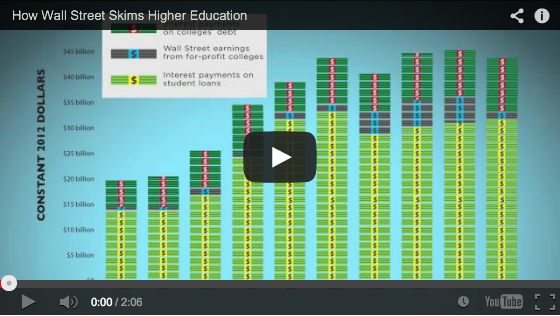
You probably didn’t know it, but tuition increases, growing student loan debt and tax dollars for public higher education are funding Wall Street profits.

In 2012, Wall Street raked in $44 billion in profits from college students, colleges and taxpayers. That’s nearly 10 percent of the total amount spent on higher education in America.

Watch the video to learn how the “Wall Street skim” is driving up the cost of opportunity for all of us.

In the last 15 years, student debt has increased more than 1,000 percent. In 2012, students and families paid Wall Street and the Department of Education $33 billion in student loan interest, while colleges paid another $7 billion in financing costs on institutional loans, and for-profit colleges raked in about $4 billion in profits.

A college education is a pathway to opportunity, but it’s getting harder to achieve because costs keep rising. Money from college tuition and taxpayer dollars shouldn’t go to Wall Street profits—it should go to making college affordable and accessible for all students.

Today, the University of California at Berkeley’s Institute for Research on Labor and Employment released a report that explains “The Hidden Costs of Financing U.S. Higher Education.” Public colleges are facing a decline in state funding, so they have to increase their debt and issue capital bonds to investors, and they push students to borrow more money from student loan profiteers. In addition, for-profit colleges continue to divert tuition from high-quality education to stockholders.

Watch the video to see how students, colleges and communities are paying for Wall Street profits.

Over the coming months, we’ll be using this report to fight to reclaim the promise of a high-quality, affordable college education. But first, we need people to know that the opportunity to get a college education is being threatened by Wall Street profits. I hope you’ll watch and share the video.

In unity,
Craig Smith
AFT Higher Education


LFT Weekly Legislative Digest: May 23, 2014

Louisiana Federation of Teachers

Weekly Legislative Digest

May 23, 2014

Steve Monaghan, President * Les Landon, Editor

2014 Regular Legislative Session

Now available on the Web at http://la.aft.org

Check out all things legislative on the LFT’s Legislative Resource Page!

Is your school ready for computerized tests? Click here to take the survey.

Tell Representatives to respect local control of schools: Click here

You’re needed at the capitol!Educators are urged to visit the capitol at 1:00 PM on Tuesday, May 27 and Wednesday, May 28. The House of Representatives will consider HB 636 by Rep. Bodi White (R-Central). The bill unfairly singles out the East Baton Rouge Parish school system to be radically restructured.Click here to learn more and send a message to your Representative.And come to the capitol on Tuesday and Wednesday!


$3.5 billion MFP approved by Senate
Next stop: House Education Committee

Public education’s $3.5 million Minimum Foundation Program has been approved by the Senate, and is scheduled for a hearing by the House Education Committee next Wednesday, May 28.

The MFP has been on a fast track to passage ever since it was amended by the Board of Elementary and Secondary Education a little over a week ago. The formula had been rejected by the Senate Education Committee because of Chairman Conrad Appel’s (R-Metairie) objection to a continuing 2.75% growth factor built into the formula.

The Senate passed the MFP as SR 55 by Sen. Appel with only one “nay” vote. Sen. Dan Claitor (R-Baton Rouge) opposes the formula because he believes it shortchanges special education services.

With the session’s June 2 deadline fast approaching, the House Education Committee will dedicate its final meeting of the session solely to the MFP. If it is approved there, it will proceed to the House floor. Adoption of the resolution does not require the governor’s signature.

Discipline & Dismissal compromise bill approved

A milestone was reached when the Senate Education Committee approved without objection a bill that alters the teacher discipline and dismissal policy in Act 1 of 2012.

HB 1277 by Rep. Jeff Thompson (R-Shreveport) replaces several sections of law that virtually abolished the due process rights of teachers who were labeled as ineffective under Act 1. If it is adopted, no longer would the superintendent have the sole final word on dismissal of teachers. Termination decisions would be reviewed by a hearing officer chosen from a list of qualified persons selected by the school board.

Unlike Act 1’s provision, in which a three-person panel’s recommendation is not binding, the hearing officer may overrule a superintendent’s decision. The bill includes a number of other revisions aimed at making sections of Act 1 into a clearer, fairer process.

The bill is the result of collaboration between the governor’s office and LFT, LAE, superintendents, school boards and others. It moves to the Senate floor, where little opposition is expected.

Common Core bill wins committee approval

A bill that would delay, but not cancel, the consequences of Common Core standards was approved by the Senate Education Committee.

HB 953 by Rep. Walt Leger (D-New Orleans) adds a year to a suspension of Common Core consequences that was previously adopted by the Board of Elementary and Secondary Education. The allowances for public schools and students will extend through the 2015-15 school year.

Rep. Leger’s bill includes a curved distribution of school letter grades to ensure that the total number of each letter grade does not change during the suspension, but allows for changes in individual schools. The Senate Education Committee stripped an amendment that would have prohibited any school from receiving a lower letter grade than in the previous year.

The bill moves to the full Senate for further action.

Teacher arrest bill goes to governor

An LFT-sponsored bill prohibiting the arrest of teachers at school for minor offenses has been approved by the legislature and awaits the governor’s signature.

HB 1108 by Rep. Terry Landry (D-New Iberia) was filed in response to an incident in a Baker school, in which a teacher was handcuffed and taken to jail after tugging on the shirt tail of a student who refused to follow a school policy.

The bill says that teachers who are accused of minor offenses cannot be arrested on school grounds, but must be issued summonses instead. The bill does not apply to serious offenses or injuries to students.

Rule making bill awaits governor’s signature

A bill that would give the public a more transparent view of the rule making process has been approved by both houses of the legislature and sent to the governor for his signature.

HB 322 by Rep. Sam Jones (D-Franklin) is part of the LFT legislative agenda. It would require the Department of Education and Board of Elementary and Secondary Education, as well as all other rule making agencies, clearly post their rule making dockets. That would give the public an opportunity to voice opinions on proposed rules before they go into effect.

Unexcused absence bill passes

A bill that would prohibit including the test scores or other measures of student growth of habitually absent students in teacher evaluations was approved by the Senate Education Committee.

HB 533 by Rep. Alan Seabaugh (R-Shreveport) passed both houses of the legislature and is awaiting the governor’s signature. Once it is signed, the scores of students who have 10 or more unexcused absences in a semester cannot be counted as part of a teacher’s evaluation.

House pans textbook selection bill

The House of Representatives voted down a bill that would have given local school systems control over the choice of textbooks and learning materials.

SB 336 by Sen. Conrad Appel (R-Metairie) would have preserved the Department of Education’s role in reviewing English, math and social studies texts, but local systems would not have been limited to materials on the list.

Opponents said that allowing a wide variance in learning materials could hamper efforts to maintain educational quality across the state.

Senate passes student privacy bill

A bill prohibiting any commercial use of student data was approved by the Senate and sent to the House for further action.

SB 685 by Sen. Eric LaFleur (D-Ville Platte) would ban the sale, transfer, sharing or processing of student data for any advertising, marketing or other commercial purpose. The bill covers state and national assessment results, transcript information, course grades and grade point averages, date of birth, attendance, mobility and grade level expectations.

It is not known whether the bill will advance further, however. The House Education Committee is expected to meet just once more, and the agenda is supposed to include just SCR 55, the MFP resolution.

Higher education could get savings from private contracts

A bill that could reduce the amount spent on private contracts and dedicate the money instead to higher education was approved by the Senate Finance Committee.

The panel adopted HB 142 by Rep. Dee Richard (Independent-Thibodaux) after it was amended to give the Joint Legislative Budget Committee authority over contracts that exceed $40,000. Money saved by rejecting or adjusting contracts for private consultants could be dedicated to higher education.

Rep. Richard has introduced versions of his bill for four years. This was the first time the idea was given a good chance of becoming law.

Voucher transfer bill passes

A bill that would allow the transfer of students from the state voucher program into a separately funded voucher program that gives donors a tax rebate was approved by the Senate and awaits the governor’s signature.

LFT is concerned that HB 708 by Rep. Kirk Talbot (R-River Ridge) will increase the total number of voucher students and the overall cost of vouchers to the state treasury, because there is no cap on the amount that may be rebated.

House approves extended sick leave bill

A common-sense change to the state’s extended sick leave law was unanimously approved by the House of Representatives.

Under current law, teachers have a right to extended sick leave under certain conditions. They may accumulate up to 90 extended sick leave days in a six-year period, and may use them at a reduced salary in 10-day blocks after all their regular sick leave is exhausted.

HB 717 by Rep. Dorothy Sue Hill (D-Dry Creek) would remove the 10-day stipulation.

COLA bill goes to governor

The Senate gave unanimous approval to a bill that triggers a 1.5% cost of living adjustment for more than 100,000 retired teachers, school employees and other public employees, but could result in smaller COLAs in future years.

HB 1225 by Rep. Joel Robideaux (R-Lafayette) was linked to bills that grant the COLA. Rep. Robideaux’ bill reserves more of the state retirement systems’ future earnings to reducing the systems’ unfunded accrued liabilities, rather than to the experience accounts that fund COLAs.

Two bills calling for COLAs have been signed by the governor; passage of HB 1225 is the last step before the raises appear in retirement checks.

The week ahead

Sunday, May 25

The Senate Revenue and Fiscal Committee will meet at 1:00 P.M.

The Senate Finance Committee will meet at 3:00 P.M. to debate HB 1, the state budget.

Monday, May 26

The Senate will convene at 3:00 P.M.

Tuesday, May 27

House Appropriations Committee: SCR 55 by Sen. Conrad Appel (R-Metairie), the Minimum Foundation Program, will be considered.

House Civil Law Committee: SB143 by Sen. Bob Kostelka (R-Monroe) and Rep. Randal Gaines (D-LaPlace) will be considered. The bill would prevent state department heads from preventing the grant of injunctions by falsely certifying that such injunctions would cause a state deficit. This is part of LFT’s package.

Wednesday, May 28

House Education Committee: The committee will consider HCR 55, the MFP, if the House accepts a suspension of the rules after the resolution is heard by the Appropriations Committee.

Senate floor: The Senate is expected to consider HB1, the state budget.


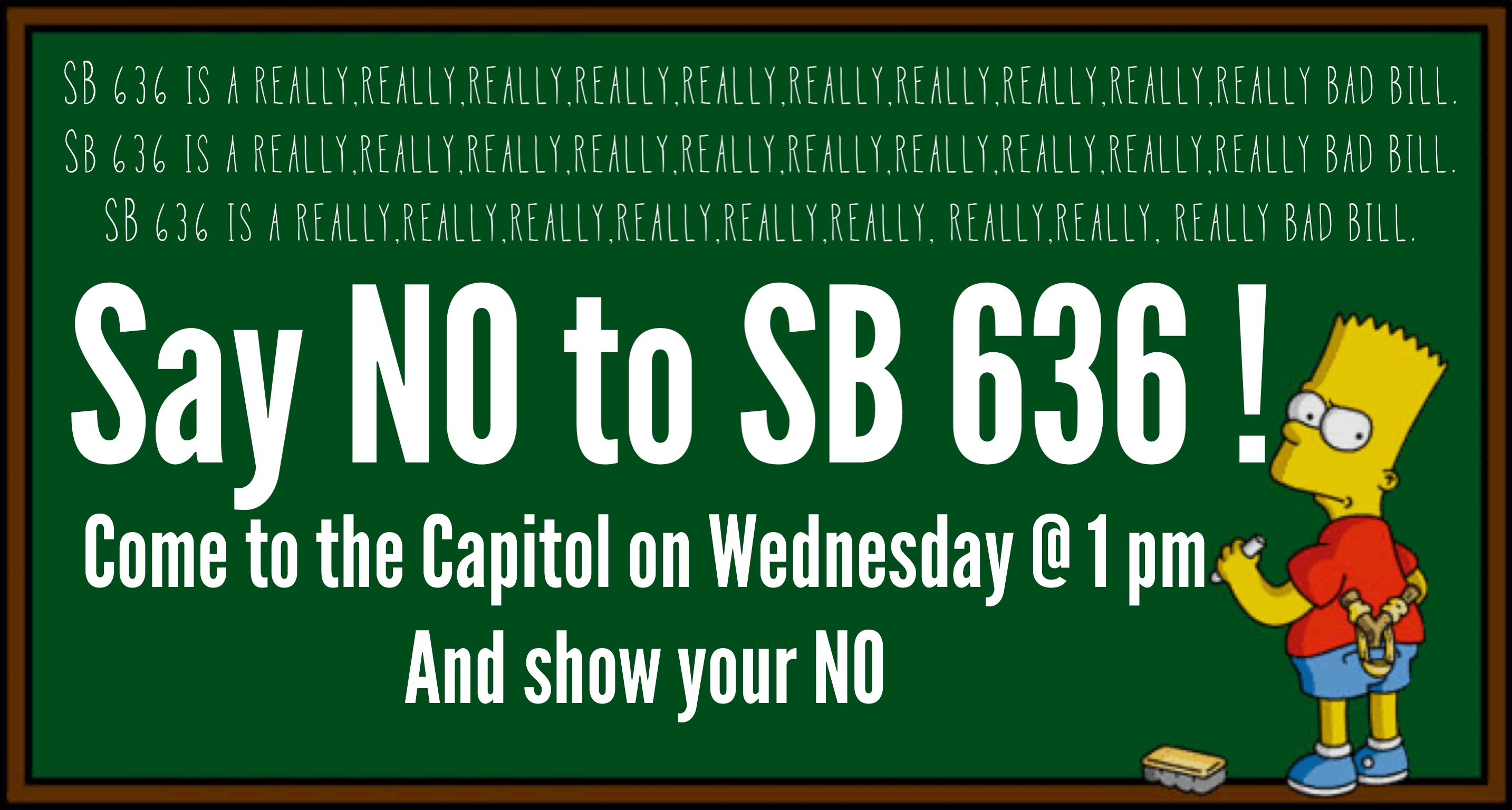
ACTION ALERT: Say NO to SB 636! Preserve Local Control of Schools!

Act now to save local control of schools! Oppose SB 636!


The vote will likely occur on Wednesday. We have been asked to help encourage teachers and school employees to come to the Capitol on Wednesday. The bill targets EBR, but make no mistake about it. EBR is only the current and first target! Contact Red River United at redriverunited@redriverunited.org for more information. 


Act now to preserve local control of schools,


or yours could be next!

The House of Representatives will soon vote on a bill that radically restructures one school system without approval of the voters.

If you believe in local control of our schools, please ask your Representative to OPPOSE SB 636 by Sen. Bodi White (R-Central).

The bill is widely seen as a back-door effort to convert all schools in East Baton Rouge Parish to charters. If the Legislature can force this change on Baton Rouge schools, then any district in the state could be next.

Here are a few of the reasons to oppose SB 636:

  • It unfairly targets one individual school system, East Baton Rouge. It will likely prompt costly litigation on the constitutionality of singling out one school system by the legislature.
  • It drastically changes the governance model of local school systems. Principals would negotiate contracts for health care and benefits, student transportation, maintenance, food service, custodial work and other functions usually handled by the central office. It is a model associated with charter schools.
  • Many principals in the EBR system testified against the bill, saying they do not have the training or resources to take on duties handled more efficiently by the central office.
  • It limits the authority of the school system superintendent and locally elected school board.
  • It creates major financial problems with the distribution of scarce state and local dollars dedicated to public education.
  • It micromanages a locally elected school board, forcing the system to do many things it already has the authority to implement at the local level.

Please send a message and ask your Representative to vote NO on HB 636!

Click here to send a message! 


FREE Downloadable Memorial Day Resources!

memorialbanner


Memorial Day

Each year, on the final Monday of May, we celebrate Memorial Day. Memorial Day is a solemn day where we remember the men and women of the United States Armed Forces who died while serving our country. The holiday was originally known as Decoration Day, a time when Americans remembered those who died during the Civil War. During the 20th century, it was expanded to include all wars. Memorial Day was declared a federal holiday in 1968.

To commemorate Memorial Day, Share My Lesson  has a special collection of lesson plans, activities, and materials that explain the history of this holiday and how it honors our nation’s fallen soldiers.

The Share My Lesson team has put together a collection of free lesson plans, materials and activities that honor our nation’s fallen soldiers by exploring the importance of Memorial Day and learning about the wars which caused so many causalities.

Guide your students’ exploration of the importance of Memorial Day and learning about the wars which caused so many causalities.

Do you know…?

  *   What this special day was originally called, before the holiday became known as Memorial Day?
  *   Which war fallen soldiers were recognized and honored for before Memorial Day became associated with all wars?
  *   What year Memorial Day was declared a federal holiday?

Find the answers with Share My Lesson!

Regards,

Share My Lesson

PS: In case you missed it, our Teacher Care Packages have been one of Share My Lesson’s most popular resources, making it easier than ever for teachers to find the most applicable resources for their classroom. Each virtual care package is organized by grade level and subject area. See which one works for you.

Find us on: Facebook, Twitter, Pinterest,  Google+


Benjamin Franklin Charter High School Okays Union Talks.


FOR IMMEDIATE RELEASE
Contact: Larry Carter, President, United Teachers of New Orleans

Benjamin Franklin board okays union talks

(New Orleans – May 16, 2014) The board of one of America’s highest performing high schools has agreed to negotiate a collective bargaining agreement with teachers. On Thursday night, Benjamin Franklin High School in New Orleans became the city’s second charter school to embrace the collective voice of their teaching staff by formally recognizing a union.

“This is an encouraging sign that great things can be accomplished when people of good will work together in the best interest of students, teachers and our schools,” said Louisiana Federation of Teachers President Steve Monaghan. “Both the faculty and the school board are to be congratulated. Overwhelming majorities of both have embraced a formal relationship with the best interest of their students in clear focus.”

Franklin’s governing board voted 9-1 to negotiate with the school’s chapter of the United Teachers of New Orleans, an LFT affiliate. The vote came several weeks after teachers presented a petition signed by more than 85 percent of the faculty asking for recognition and a collective bargaining agreement.

Larry Carter, President of United Teachers of New Orleans, praised the teachers at Franklin for their courage.  “It can be very intimidating to speak publicly about issues at your school,” he said. “I admire the tenacity and strength the teachers at Franklin demonstrated last evening.”

A math teacher at the school, Mark Quirk, praised Franklin’s leadership for its decision. “The board’s name is Advocates for Academic Excellence in Education and they lived up to that name,” Quirk said. “We look forward to working with the board and administration to maintain Franklin as the best public high school in the state.”

LFT Weekly Legislative Digest: May 16, 2014

Louisiana Federation of Teachers

Weekly Legislative Digest

May 16, 2014

Steve Monaghan, President * Les Landon, Editor

2014 Regular Legislative Session

Now available on the Web at http://la.aft.org

Check out all things legislative on the LFT’s Legislative Resource Page!

Is your school ready for computerized tests? Click here to take the survey.

Senate panel approves $3.5 billion MFP

Monaghan: Fear drives acceptance of this formula

Two weeks after the Senate Education Committee deferred public education’s $3.5 billion Minimum Foundation Program, the spending formula returned to the same panel with a very different result. In the interim, the Board of Elementary and Secondary Education met to strip a recurring 2.75% growth factor from the formula.

That, along with a couple of other amendments, was enough to satisfy the objection of Senate Education Committee Chairman Conrad Appel (R-Metairie), who had deferred his own SCR 55 over the issue.

LFT President Steve Monaghan acknowledged that the resolution now probably has enough support to win legislative approval. However, he said, the Federation has a number of concerns about the spending plan.

“Fear drives acceptance” of the MFP, Monaghan told the panel. Lawmakers and educators alike worry that if no formula is adopted this year, K-12 education could experience drastic cuts next year. A deficit of between $400 million and $1 billion is being predicted because budgetary tricks over the past few years have masked the state’s true fiscal picture.

Monaghan said the failure to approve an annual 2.75% growth factor practically guarantees that the increase will not be reflected in future formulas.

The LFT president commended BESE for including a continuance of last year’s one-time pay raise for teachers, but noted that it amounted to between $190 and $1,200 per teacher, paltry when considering that there have been no state teacher raises since 2008.

However, Monaghan said, it is shameful that the state has granted no pay raises for school support staff, many of whom earn between $12,000 and $17,000 per year.

Retired special education teacher Mike Myers said the proposed MFP shortchanges special education services by requiring districts to compete for $8 million for severely impaired students.

The LFT was the only organization to speak on the proposed MFP formula.

Superintendent of Education John White told BESE that the new formula “undoes” amendments to the state budget that were reported in last week’s LFT Legislative Digest, including the diversion of an increase in voucher spending for the purchase of computers for schools.

The plan also deletes funding for state schools, including the Louisiana School for Math Science and the Arts and the New Orleans Center for Creative Arts from the formula. They will be funded through a line item in the state budget.

Depending on the outcome of another bill, the MFP will allow local school districts to determine whether or not providers of controversial “course choice” options will be funded through the formula.

New Orleans charter board agrees to negotiate contract

The board of one of America’s highest performing high schools has agreed to negotiate a collective bargaining agreement with teachers. On Thursday night, Benjamin Franklin High School in New Orleans became the city’s second charter school to embrace the collective voice of their teaching staff by formally recognizing a union.

“This is an encouraging sign that great things can be accomplished when people of good will work together in the best interest of students, teachers and our schools,” said Louisiana Federation of Teachers President Steve Monaghan. “Both the faculty and the school board are to be congratulated. Overwhelming majorities of both have embraced a formal relationship with the best interest of their students in clear focus.”

Franklin’s governing board voted 9-1 to negotiate with the school’s chapter of the United Teachers of New Orleans, an LFT affiliate. The vote came several weeks after teachers presented a petition signed by more than 85 percent of the faculty asking for recognition and a collective bargaining agreement.

Larry Carter, President of United Teachers of New Orleans, praised the teachers at Franklin for their courage.  “It can be very intimidating to speak publicly about issues at your school,” he said. “I admire the tenacity and strength the teachers at Franklin demonstrated last evening.”

A math teacher at the school, Mark Quirk, praised Franklin’s leadership for its decision. “The board’s name is Advocates for Academic Excellence in Education and they lived up to that name,” Quirk said. “We look forward to working with the board and administration to maintain Franklin as the best public high school in the state.”

Bill limiting teacher arrests proceeds

An LFT-sponsored bill prohibiting the arrest of teachers at school for minor offenses was approved by the Senate Judiciary A Committee.

HB 1108 by Rep. Terry Landry (D-New Iberia) was filed in response to an incident in a Baker school, in which a teacher was handcuffed and taken to jail after tugging on the shirt tail of a student who refused to follow a school policy.

East Baton Rouge Federation of Teachers President Carnell Washington said it was a travesty of justice to jail a teacher for simply telling a student to tuck in his shirt tail.

The bill says that teachers who are accused of minor offenses cannot be arrested on school grounds, but must be issued summonses instead. The bill does not apply to serious offenses or injuries to students.

The bill will move to the Senate floor for further action.

Bill to halt charter abuse dies in committee

The Senate Education Committee – becoming known as the place where good bills go to die – killed a bill aimed at restoring local control to the approval of some charter schools.

HB 703 by Rep. John Bel Edwards (D-Amite) would have prohibited the Board of Elementary and Secondary Education from approving charter schools that had been denied by school boards in districts with grades of A, B or C.

The bill had been approved by the House Education Committee, and was passed by the full House.

Pleading for his bill before the Senate committee, Rep. Edwards said HB 703 is “not an anti-charter bill. It just changes who makes the decision (to issue a charter) under certain circumstances.”

Rep. Edwards pointed to Lafayette Parish, a B graded district in which the school board had rejected a charter school application. The decision was overridden by BESE, which is widely seen as having a blatant pro-charter bias.

When BESE can overrule a high-performing school district, Rep. Edwards said, it removes any incentive for charter applicants to cooperate with the local school board.

“This is a modest bill just asking for some trust in local school boards,” said Rep. Edwards.

The committee voted unanimously to defer the bill.

Committee approves change to sick leave rule

A common-sense change to the state’s extended sick leave law was approved by the House Education Committee and sent to the floor for a vote.

Under current law, teachers have a right to extended sick leave under certain conditions. They may accumulate up to 90 extended sick leave days in a six-year period, and may use them at a reduced salary in 10-day blocks after all their regular sick leave is exhausted.

HB 717 by Rep. Dorothy Sue Hill (D-Dry Creek) would remove the 10-day stipulation. As LFT Legislative Director Mary-Patricia Wray explained to the committee, requiring a teacher to take 10 days of sick leave if only one or two are required makes little sense.

The committee approved the bill without opposition.

Senate panel rejects reverse parent trigger bill

A bill intended to improve a reverse parent trigger law adopted last year was rejected by the Senate Education Committee.

HB 73 by Rep. Ted James (D-Baton Rouge) would have allowed any parent of a school operated by the Recovery School District to petition for the school to be returned to control of the local school district. Under current law, parents may not sign such a petition unless their children have attended the RSD school for at least two years.

Rep. James said the existing law is flawed because the two-year limitation means that parents of children in middle schools, which typically have just three grades, would have little opportunity to act.

The bill is considered a reverse parent trigger because other laws exist which allow for parents to petition the RSD to seize control of a district school. Rep. James said his bill is prospective because after next year, there will be no schools directly operated by the RSD, but there could be some in the future.

The committee deferred the bill without objection.

House panel okays restructure of Baton Rouge schools

Despite the strenuous objection of principals, teachers, parents and school boards, the House Education Committee approved a bill that will radically transform the governance of the East Baton Rouge Parish school system.

SB 636 by Sen. Bodi White (R-Central) would create new community school councils and give principals greater authority over personnel decisions, as well as contracting for a range of services. In addition to academic responsibilities, each principal would become the CEO of a school, and would have to arrange for transportation, food service, janitorial and maintenance services, and employee benefits such as health insurance.

Opponents said that the new duties are more efficiently handled by central office administrators. Many believe that the proposed governance system would lead virtually all schools in Baton Rouge to become charters. Some legal experts say the bill may violate a constitutional prohibition on passing bills aimed at changing governance in just one body.

The bill is a mirror image of one by Education Committee Chairman Steve Carter (R-Baton Rouge), which stalled in the committee two weeks ago.

In a related issue, Sen. White shelved his effort to reduce the size of the Baton Rouge school board. White’s SB 672 would have sliced eh board from its current 11 members to nine. The senator said the board is looking at voluntarily redistricting and reducing the number of members, making his bill unnecessary.

Rule making bill moves forward

The public will find it much easier to follow the progress of proposed rules if HB 322 by Rep. Sam Jones (D-Franklin) becomes law.

The bill would require agencies like the Department of Education and Board of Elementary and Secondary Education to clearly post their rulemaking dockets. In the past, it has often been difficult to track a rule change during its promulgation period. That is the time in which the public has the right to comment on the rule before it becomes finally adopted.

HB 322 has been adopted by the House of Representatives, and was approved by the Senate and Governmental Affairs Committee. The bill, which is part of the LFT legislative agenda, will move to the Senate floor for a vote.

Equal pay bill proceeds

SB 322 by Sen. Edwin Murray (D-New Orleans) is an equal pay protection bill that creates a mechanism to enforce equal pay for women. The bill, which is supported by LFT, was approved by the House Labor Committee, and sent to the House floor for a vote.

Truth and transparency bill killed

One bill aimed at making sure appointed officials tell the truth in affidavits was killed in committee this week, but another version of the bill is still awaiting action.

HB 181 by Rep. Randal Gaines (D-LaPlace) was involuntarily deferred by the Senate Judiciary A Committee. It would have prevented appointed officials from falsely certifying that granting an injunction would create a state budget deficit. Under current law, the truthfulness of such an affidavit cannot be questioned in court. HB 181 would have allowed courts to decide if an affidavit is factual.

A similar bill, SB 143 by Sen. Bob Kostelka (R-Monroe), is awaiting action in the House of Representatives.

Bill could double the cost of vouchers

A bill that could drain twice as much money from state coffers as the current voucher scheme was approved by the Senate Revenue and Fiscal Affairs Committee.

HB 780 by Rep. Kirk Talbot (R-Metairie) would allow students who attend private and religious school on vouchers to be eligible instead for participation in a voucher rebate program. The bill could drain more students and their associated funding from public schools.

LFT also opposes this bill because it has no mechanism to audit participating schools.

The bill failed to pass out of the committee on a first vote. But as time passed and some members had to leave, the bill was brought back up and was approved.

Voucher savings bill approved

A voucher-related bill that could save the state some money was approved by the Senate Finance Committee

SB 656 by Sen. Sherri Buffington (R-Keithville) would allow donors to make contributions directly to voucher schools, offsetting the cost of state vouchers. Any money saved as a result would be removed from the Department of Education budget and sent to the state’s over collections fund.


Sex ed bill deferred by House panel

For the fifth year in a row, a bill mandating sex education in public schools was rejected by the House Education Committee.

Rep. Patricia Smith (D-Baton Rouge) said she will continue to bring the issue to the legislature to help staunch Louisiana’s high rate of sexually transmitted diseases and teen pregnancies.

Her HB 369 would have required age-appropriate instruction on human sexuality in grades four through 12, urging students to “make responsible decisions about sexuality and relationships.”

It would have prohibited advocacy of abortion and required teaching abstinence as the most effective was to avoid pregnancy and STDs.

The bill failed on a 3-10 vote.

Senate panel okays unexcused absence bill

A bill that would prohibit including the test scores or other measures of student growth of habitually absent students in teacher evaluations was approved by the Senate Education Committee.

If HB 533 by Rep. Alan Seabaugh (R-Shreveport) becomes law, the scores of students who have 10 or more unexcused absences in a semester could not be counted as part of a teacher’s evaluation.

The bill originally included just test scores. But with the Value Added Model on the shelf for two years, the bill was amended to include any measure of student growth. The bill will be heard next on the Senate floor.

Public school choice bill proceeds

A bill that would allow students in schools with low state-issued grades to transfer to higher rated schools was approved by the House Education committee.

SB 61 by Sen. Ben Nevers (D-Bogalusa) would allow children in schools with grades of D or F to transfer to higher rated schools either inside or outside their district. The receiving schools must be rated A, B or C, and must have space available. An amendment made the bill permissive, if districts agree to allow the transfers.

LFT opposed the bill. President Steve Monaghan said the union does not accept the validity of the grading system, which is subject to manipulation by the State Department of Education. Instead of moving student around, Monaghan said, the state should address issues that lead to low academic performance.

Senate approves “empowered schools”

A bill that would allow one principal in each school system to assume more control of their schools was approved by the Senate and sent to the House for further action.

SB 385 by Sen. Eric LaFleur (D-Ville Platte) allows one principal in each district to declare a school “empowered” so long as the principal is rated highly effective. The principal would then have more control over the budget, scheduling, course offerings and other issues.

Panel okays privatization oversight bill

The privatization of state services will come under closer scrutiny if HB 128 by Rep. Kenny Havard (R-Jackson) completes its legislative journey.

Rep. Havard’s Privatization Review Act would prohibit any state agency from entering into privatization agreements unless the agreements met certain standards, and would subject the contracts to legislative oversight.

The bill was approved without objection by the House and Governmental Affairs Committee.


The Week Ahead

Monday, May 19

Senate Finance Committee: The $3.5 billion Minimum Foundation Program will be on the agenda.

Senate Floor: HB1225 by Rep. Joel Robideaux (R-Lafayette) will be debated for final passage. The bill would pump some future retirement system earnings into the unfunded accrued liability, making it unlikely that COLAs will be granted going forward. LFT opposes this bill, but it is linked to SB19 and SB21 which are supported by LFT. Those provide 1.5% COLAs this year. They have been finally passed and await either signature or veto. But all these bills must be passed (and not vetoed) in order for any of them to go into effect.

HB1108 by Rep. Terry Landry (D-New Iberia) provides for issuance of a summons, not an arrest warrant, in alleged cases of misdemeanor activity of a teacher related to their job duties. This is part of LFT’s legislative agenda.

Wednesday, April 21

House Education Committee: HCR114 by Rep. Patricia Williams will urge and request BESE to create policies that ensure students get enough time to consume lunch. This resolution is in response to shortened lunch periods to make more time for test prep. In high poverty districts, time to eat a nutritious meal is important. This is part of LFT’s legislative agenda.

HB129 by Rep. Kenny Havard (R-Jackson) would prevent charter schools from contracting for operation of the charter school with a for-profit company. LFT supports this bill.

HB947 by Rep. Havard would lower the required percentage of a teacher’s evaluation that is based on Value Added data. LFT supports this bill.




URGENT: Act Now to Save Local Control of Schools

Act now to preserve local control of schools,
or yours could be next!

The House of Representatives will soon vote on a bill that radically restructures one school system without approval of the voters.

If you believe in local control of our schools, please ask your Representative to OPPOSE SB 636 by Sen. Bodi White (R-Central).

The bill is widely seen as a back-door effort to convert all schools in East Baton Rouge Parish to charters. If the Legislature can force this change on Baton Rouge schools, then any district in the state could be next.

Please click here to learn more and send your Representative a message!

LFT Weekly Legislative Digest- May 9, 2014

Louisiana Federation of Teachers

Weekly Legislative Digest

May 9, 2014

Steve Monaghan, President * Les Landon, Editor

2014 Regular Legislative Session

Now available on the Web at http://la.aft.org

Check out all things legislative on the LFT’s Legislative Resource Page!

House passes teacher raise, trims vouchers

Taking advantage of a rare opportunity, the House of Representatives put its own stamp on education funding, approving a teacher pay raise and scaling back the amount to be spent on vouchers.

In most years, the legislature’s only option is to accept or reject the spending formula adopted by the Board of Elementary and Secondary Education. Lawmakers may not alter it. But this year the state’s $25 billion operating budget, HB1, hit the House floor while education’s Minimum Foundation Program is held up in the Senate Education Committee.

That opened the way for Rep. John Bel Edwards (D-Amite) to reallocate the $70 million increase in last year’s education budget and require that half of the funds again go to teacher pay raises.

A second amendment by Rep. Edwards allocated $14 million in new funds for the stalled MFP to school boards’ contribution s to state retirement systems.

The third amendment eliminated a proposed 5% per-pupil increase in voucher spending. Instead, the money will be used to purchase technology equipment needed to administer online assessments in third through eighth grade.

The amendments, which had the support of the LFT and school boards, total almost $90 million in renewed and increased support for public schools.

The amended budget passed the House floor on a 65-34 vote.

The ultimate fate of the $3.5 billion MFP is still up in the air. Questions abound about whether or not there is time left in the session for the Board of Elementary and Secondary Education to revise the formula and shepherd it through the legislative process.

Budget takes a slap at PARCC

After being frustrated at several attempts to derail Common Core standards and the related Partnership for Assessment of Readiness for College and Careers (PARCC) test, Rep. Bret Geymann (R-Lake Charles) was able to hit the test where it may hurt most – in the budget.

Geymann convinced his colleagues to adopt an amendment to HB1 requiring competitive bids for any tests designed to assess student achievement in line with Common Core standards.

Rep. Geymann said that although he was unable to stop Common Core in this session, he wants to make sure the state gets the best price possible on what is expected to be an expensive testing regimen.

His final attempt to completely derail PARCC, HB 380, would have prohibited the use of state funds for testing without further legislative approval. That bill failed in the House Appropriations Committee.

Tony Danza gift closes out Teacher Appreciation Week

As we celebrate and close out Teacher Appreciation Week 2014, the American federation of Teachers has a gift for you―actor Tony Danza’s autobiography of his rookie year teaching at Northeast High School in Philadelphia.

The Federation will send a complimentary copy of I’d Like to Apologize to Every Teacher I Ever Had (available while supplies last), courtesy of the AFT and Share My Lesson.

To get your copy, simply fill out this form.

Please note that you will need to include your Share My Lesson username. If you don’t have one, it’s easy to set up a free Share My Lesson account.

House passes due process compromise bill

The House of Representatives passed, without objection, HB 1277 (formerly HB 987) by Rep. Jeff Thompson (R-Bossier City).

The bill is the result of hours of negotiations between the Jindal administration, the LFT and other organizations including the LAE, A+PEL, school board, principals and superintendents.

The bill would replace several sections of law that virtually abolished the due process rights of teachers who were labeled as ineffective under Act 1. No longer would the superintendent have the sole final word on dismissal of teachers. Termination decisions would be reviewed by a hearing officer chosen from a list of qualified persons selected by the school board.

The bill was amended to guarantee that teachers will be notified by certified letter, and that a court reporter will record the proceedings of the hearing.

Common Core bill would freeze letter grades

A bill aimed at extending the implementation of Common Core Curriculum Standards was amended by the House of Representatives to prevent school letter grades from dropping as the new standards go into effect.

As approved by the House Education Committee, HB 953 by Rep. Walt Leger (D-New Orleans) would have simply extended the implementation of Common Core standards for a year past the current deadline. The new standards would go into effect in the 2016-17 school year. Statewide data would be collected from Common Core aligned assessments in the interim in order to establish a baseline.

On the House floor, Rep. John Bel Edwards proposed an amendment to guarantee that school letter grades would not be affected by the assessments during the transition period. His amendment passed by 50-41. The bill was then approved by 66-33.

The House rejected an amendment by Rep. Cameron Henry (R-Metairie) that would have allowed local school districts to substitute other instruments for the controversial PARCC standardized test.

Senate panel approves Value Added review

The Senate Education Committee unanimously approved a bill that would subject the controversial Value Added Model of teacher evaluation to serious review.

HB 415 by Rep. Frank Hoffman (R-West Monroe) would empower a committee to study VAM and ensure that it is a fair and accurate evaluation tool before it is re-implemented in 2015.

Rep. Hoffman said that problems have arisen around the state in which teachers have been given VAM ratings that seem out of line with the achievement of their students. He said that some schools with “A” grades have a high number of “Ineffective” rated teachers, while some graded “D” or “F” by the state have a large number of “Highly Effective” rated teachers.

The bill will convene an existing subcommittee of the accountability commission, including six classroom teachers and a member of the House and Senate. The committee will be expected to issue a report 60 days prior to the start of the 2015 school year.

Common Core assault fizzles in Senate committee

The last of numerous bills aimed at stopping Common Core standards and the associated tests was killed by the Senate Education Committee.

SB 669 by Sen. A.B. Crowe (R-Slidell) would have banned Common Core standards in Louisiana, as well as tests such as PARCC. New state standards would be drafted by a 21-member commission representing teachers, parents, business and religious organizations. The only tests allowed would be LEAP, ACT, NAEP and a new assessment developed by the commission.

Opponents questioned the cost of creating an entirely new set of standards and tests, which has been estimated to be as high as $67 million over five years, as well as the unwieldy process outlined in the bill.

Supporters attacked the credibility of Common Core standards, and noted that some states are backing away from their commitment to the standards

The committee gave supporters of the bill ample time to make their case – testimony lasted more than four hours.

At the end, though, only one of the committee’s seven members, Sen. Elbert Guillory (R-Opelousas), supported Sen. Crowe’s bill.

Observers said the end of legislative efforts to stop Common Core will put increased pressure on Gov. Bobby Jindal to veto further participation. The governor’s office submitted a card of support for SB 669, but sent no one to testify on its behalf.

Parent trigger bill proceeds after re-vote

It took two votes to accomplish, but Rep. Ted James (D-Baton Rouge) prevailed in shepherding an improved parent trigger bill through the House Education Committee.

HB 735 would allow any parent of a student in a school operated by the Recovery School District to petition for the school to be returned to control of the local school district. Under current law, parents may not sign such a petition unless their children have attended the RSD school for at least two years.

In addition, the bill would allow parents to petition for returning schools to local control even if they are slated for conversion to a charter school.

The bill was opposed by the Jindal administration, the Department of Education and charter advocates, but had the full support of the LFT.

Supporters pointed out that schools run by the RSD often have much poorer academic achievement than locally operated schools.

On a first vote, HB 735 failed on a 6-6 tie vote. But it was reconsidered after two more committee members entered the room, and won approval by 8-7.

Panel okays voucher accountability bill

A bill that would make voucher spending more transparent cleared a hurdle when the House and Governmental Affairs Committee approved SB 460 by Sen. Robert Adley (R-Benton).

The bill would require schools that accept voucher funds to maintain separate accounts for the money to facilitate proper auditing.

Outcomes based higher-ed bill proceeds

Over the objection of the LFT, a bill that would create a new funding formula for higher education institutions was approved by the House Education Committee.

SB 377 by Sen. Conrad Appel (R-Metairie) seeks to base the funding that colleges receive on a series of performance measures tied to workforce development, one of the key buzzwords of this year’s legislative session.

LFT President Steve Monaghan said that while the Federation does not oppose the intent of the bill, but has concerns about its unintended consequences. The liberal arts could suffer if workforce concerns dictate the whole higher education budget.

“The need for efficiencies is driving everything,” Monaghan said, “but there is a question of balance…The alignment of workforce concerns could equal the deprivation of funding for other important disciplines.”

Charter school retirement bill moves to committee

Facing time restraints as the session passed its halfway mark, the House Appropriations Committee discharged HB 37 by Rep. Kevin Pearson (R-Slidell) without action, moving it to the House Retirement Committee instead.

The bill would require the Department of Education to ensure that charter schools’ fair share of the retirement system’s unfunded accrued liability by transferring MFP dollars directly to the retirement system. LFT supports the bill.

Rep. Pearson is the chairman of the Retirement Committee.

House okays bill to limit future retirement COLAs

A bill that would severely limit future cost of living adjustments for public retirement system members was unanimously approved by the House of Representatives.

HB 1225 by Rep. Joel Robideaux (R-Lafayette) would require more of future retirement system earnings to go toward reducing the systems’ unfunded accrued liability instead of COLAs. The bill is linked to two COLA bills that are working their way through the legislative system.

In passing the bill, the House rejected a complicated amendment by Rep. Jack Montoucet (D-Crowley) that would have preserved some of the funds for COLAs.

Fair substitute pay bill proceeds

A bill requiring school boards to pay school employees as substitute teachers when called upon was approved by the Senate Education Committee without objection.

HB 242 by Rep. James Ames (D-Leesville) says that if a school employee who earns less than a substitute teacher is asked to sub for an absent teacher, the employee must be paid enough to make up the difference in salary for the time served as a sub.

Bill to restructure Baton Rouge board progresses

A legislative effort to meddle in local affairs that failed in the House of Representatives got new life when the Senate Education Committee unanimously approved SB 672 by Sen. Bodi White (R-Central).

Sen. White’s bill would require the East Baton Rouge Parish School Board to shrink from 11 members to nine or fewer. A mirror image of the bill was defeated in the House of Representatives.

As amended, Sen. White’s plan will become “null and void” if the school board voluntarily redistricts before the next school year.

Acknowledging that that idea has not fared well on the House side, Sen. White simply said, Send it over there and see what happens,”

What happened to the OGB surplus?

The House Appropriations Committee asked – but got few answers – why a $500 million surplus that existed in the Office of Group Benefits just two years ago has dwindled to less than $300 million.

When asked about the loss of some $20 million a month, administration officials said that the solution is to “reduce claim costs.”

Despite the lack of information as to how OGB can continue to operate once the entire surplus is spent, the committee approved the state supplemental budget (HB 262 by Rep. Jim Fannin (R-Jonesboro). The operating budget for the OGB, which provides health insurance for state workers, is funded through this supplemental bill.

The Division of Administration claimed that, through a private/public partnership with Blue Cross Blue Shield, a 19% reduction in administrative costs has been recognized.

One up, many down for TOPS bills

Of the 25 or so bills introduced this year that would change the popular TOPS college scholarship program, only one has made it out of committee thus far.

SB 520 by Sen. Jack Donohue (R-Mandeville) won unanimous approval from the Senate Education Committee. It would require a higher grade point average and ACT score to get the state funding.

Another TOPS bill did not fare as well. HB 1153 by Rep. Joe Harrison (R-Gray) was rejected by the House Education Committee. The bill would have raised the eligibility requirements for obtaining a scholarship. It would also have pegged a college freshman’s payment at 80 percent of tuition, 90 percent for sophomores, 100 percent for juniors and 120 percent for seniors.

Rep. Harrison said that unless changes are made in the TOPS program, it will eventually bankrupt the state. The estimated cost for the tuition program is $235 million next year, and will rise to $300 million in the next three years, he said.

The Week Ahead

Monday, May 12

House Floor:

HB 735 by Rep. Ted James (D-Baton Rouge) would expand the right of parents to petition for return of a recovery District school to local control. This bill is part of LFT’s legislative agenda.

Tuesday, May 13

House Floor:

SB 19 and SB 21 by Sen. Elbert Guillory will be heard, providing cost of living adjustments for retired teachers and school employees.

HB 38 by Rep. Kevin Pearson (R-Slidell), which rises the retirement age for future hires only, is scheduled for concurrence, the last step in the passage process.

House Education Committee:

SB 636 by Sen. Bodi White (R-Baton Rouge) would require the East Baton Rouge Parish School Board to reduce its membership.

House and Governmental Affairs:

HB 128 by Rep. Kenny Havard (R-Jackson) would create more legislative oversight for privatization contracts.

Joint Legislative Committee on the Budget: The panel will meet to review annual reports from the four state retirement systems including TRSL and LSERS.

Wednesday, May 14

House Education Committee:

HB 717 by Rep. Dorothy Sue Hill (D0Dry Creek)Hill will remove the “10 day at a time” requirement for use of extended sick time that exists under current law. The bill is and is part of LFT’s legislative agenda.

Thursday, May 15

House Labor: SB 322 by Sen. Edwin Murray (D-New Orleans) would create enforcement mechanisms for equal pay for women. LFT supports this bill.

Senate Education Committee: HB703 by Rep. John Bel Edwards (D-Amite) would prohibit the Board of Elementary and Secondary Education from approving Type 2 charter schools over the objection of local school boards if the local system has a grade of “C” or better.

CORRECTION: An article in last week’s Legislative Digest reported the vote on HB 451 by Rep. Alan Seabaugh (R-Shreveport) was a 6-6 tie. The actual vote was an 8-8 tie.


BREAKING NEWS: Solidarity Wins the Day for Public Employees

Solidarity wins the day for public employees

Thanks in large part to a strong show of unity among public sector employees, an effort to silence the voices of teachers, school employees and other public servants was stopped in its tracks on Wednesday.

HB 451 by Rep. Alan Seabaugh (R-Shreveport) was aimed straight at organizations like the LFT, and would have prohibited teacher unions from collecting member dues through payroll deduction. The attempt to decimate unions was pushed by the Louisiana Association of Business and Industry and a deep-pockets lobby from Washington, D.C., the National Right to Work Committee.

Rep. Seabaugh and a LABI lobbyist feigned innocence, saying the bill was not intended to harm the unions, but simply to free local agencies from the burden of collecting dues.

LFT President Steve Monaghan called them on their tactic, saying “Don’t pretend we’re not being targeted. The voice you wish to suppress is the voice you don’t want to hear.

Opponents believe the bill was filed as retribution for winning lawsuits against vouchers and teacher dismissal policies, for opposing the way that Common Core and standardized testing have been imposed, for questioning the way the Department of Education develops policies in secret and other issues.

“This is a classic case of overreach,” Monaghan said. “You want to take away the voice of public employees through their unions.”

Several members of the committee spoke up for the employees, noting that payroll deduction is a service offered to numerous vendors, including credit unions, insurance companies and others.

Spokesmen for other unions stood united against the assault on teachers and school employees. Chad Major of the firefighters’ union and Chris Stewart of the police union both spoke against the bill, even though their unions were not targeted.

There was plenty of evidence that teacher unions have the support of their communities, if not of their local state legislator. Red River United President Jackie Lansdale came armed with a Caddo Parish School Board resolution in support of payroll deduction for union dues. One of the school board members supporting the union is also the chairperson of Rep. Seabaugh’s local Republican Party.

When the dust settled, the House Labor and Industrial Relations Committee deadlocked in a 6-6 tie, and the bill failed to win approval.